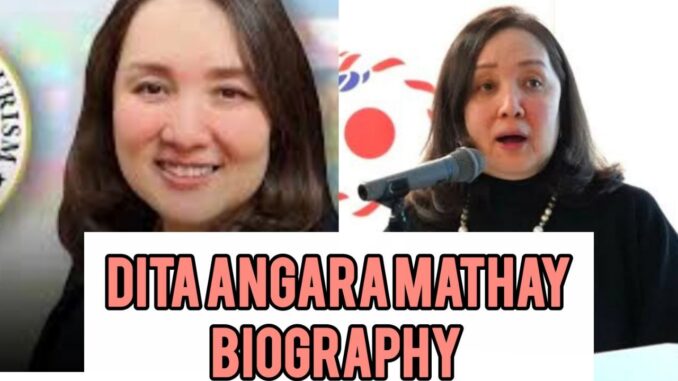
Dita Angara Mathay Biography
Dita Angara Mathay was born on July 21, 1984, in Manila, Philippines. She grew up in one of the most influential political and public-service families in the country. Her lineage connects her directly to the Angara political dynasty — a family with deep roots in Philippine governance, law, and leadership — and to the Mathay family, which has its own long tradition of public service and local government leadership. Dita Angara Mathay is 41 years old as of 2026.
Her family heritage also stretches back to Manuel Tinio, a celebrated Filipino revolutionary figure, which places her in a line of Filipinos who have played defining roles in the country’s history. Growing up surrounded by public servants and policy-makers, it is no surprise that Dita chose a career that would take her to the highest levels of international diplomacy and trade representation. She carries that tradition forward with a modern, globally connected approach to governance.
Although her specific academic degrees have not been widely made public, her career path through the Foreign Trade Service Corps of the Philippines strongly indicates advanced training in economics, international trade, or public administration. In the world of diplomacy, a person’s achievements often speak louder than their academic record, and Dita’s accomplishments across decades of service reflect a thorough and disciplined education in the workings of global trade and investment policy.
Dita Angara Mathay Personal Life
Dita Angara-Mathay is married to Robbie Mathay, who formerly served as President of the Aurora Pacific Economic Zone and Freeport Authority (APECO). Their union brings together two prominent Filipino families — the Angaras and the Mathays — both of which have contributed significantly to Philippine public life over multiple generations. Together, they represent a family deeply invested in the welfare and development of the nation.
On a personal level, Dita maintains a notably private life. Despite her high profile in trade and diplomatic circles, she has kept personal matters away from the public eye and has no known controversies in her personal life. She is widely respected as a professional who lets her work define her public image. Her ethnicity reflects her Ilocano and Aurora roots through the Angara family lineage, and like the majority of Filipinos, she is widely believed to practice the Roman Catholic faith, though she has not made public statements on this.
People who have worked alongside her describe her as strategic, grounded, and deeply committed to the welfare of Filipino businesses and communities. She is known for leading by example — building relationships through consistent, long-term engagement rather than short-term visibility. Those who know her both personally and professionally speak of someone who sees her work not just as a career, but as a continuation of a family legacy of service to the Filipino people.
Dita Angara Mathay Career
Dita Angara-Mathay built her career within the Foreign Trade Service Corps (FTSC) of the Philippines, the specialized government body responsible for promoting Philippine trade, investment, and economic interests abroad. She climbed steadily through the ranks by combining expertise in trade policy with a talent for building lasting international partnerships — a skill that would define her career for decades.
Her most significant posting was as Commercial Counsellor and Special Trade Representative at the Philippine Trade and Investment Center (PTIC) in Tokyo, Japan, where she was based at the Philippine Embassy. In this role, she served as one of the Philippines’ top economic diplomats in Asia, responsible for promoting Philippine exports, attracting Japanese investments into the country, and building strong business ties between the two nations. Japan is one of the Philippines’ largest trading partners and a major source of foreign direct investment, making her position one of the most consequential in Philippine trade diplomacy.
Under her leadership at the PTIC in Tokyo, she facilitated major investment projects worth billions of pesos and strengthened economic cooperation across multiple industries. She championed cultural diplomacy alongside economic strategy — leading notable initiatives such as the “Philippine Coconut: Tree of Life” exhibition, which promoted Filipino sustainability, innovation, and cultural identity to Japanese audiences. She also supported Philippine participation in Tokyo Fashion Week, helping position Filipino creativity and craftsmanship as a legitimate driver of trade and international brand recognition.
“Throughout her career, Angara-Mathay has led programs that link global partnerships to concrete outcomes on the ground, supporting enterprise development, strengthening industries, and expanding opportunities for Filipino businesses, especially MSMEs.”— Malacañang Palace, Presidential Communications Office, April 2026
Her leadership style is consistently described as strategic, globally connected, and policy-oriented. She has a reputation for blending hard economic strategy with soft cultural diplomacy — understanding that trade relationships are built not only on data and contracts, but also on mutual respect and cultural understanding. She placed particular emphasis on supporting micro, small, and medium enterprises (MSMEs) — making sure that the gains from international trade reached Filipino entrepreneurs at every level of the economy, not just large corporations.
Dita Angara Mathay Appointment
On April 10, 2026, President Ferdinand Marcos Jr. appointed Dita Angara-Mathay as the new Secretary of the Department of Tourism (DOT) of the Philippines. The appointment was announced by the Presidential Communications Office (PCO), which described her as a “seasoned public servant” who would bring “decades of experience in trade, investment, and international economic engagement” to the tourism department.
She replaced Christina Garcia-Frasco, who had served as the DOT’s first secretary under President Marcos. Frasco had been reassigned as Presidential Adviser for Sustainable and Resilient Communities in March 2026, a move that came amid criticism over the department’s failure to meet its own tourism targets and controversy over the prominence of Frasco’s own image — rather than Philippine tourism destinations — in the DOT’s promotional materials. Following Frasco’s exit, DOT Undersecretary Verna Buensuceso had been designated as officer-in-charge of the agency while the search for a new secretary was underway.
Malacañang made it clear that Dita’s appointment was a strategic choice — one designed to align the Department of Tourism more closely with the administration’s broader economic growth agenda. The PCO stated that her appointment “reflects the administration’s push to position tourism not only as a cultural showcase, but as a strong driver of jobs, businesses, and regional development.” The Marcos administration signaled that under her leadership, the DOT would work to attract more investments into the tourism sector, support local industries connected to travel and hospitality, and ensure that the economic benefits of tourism spread to communities across all regions of the Philippines.
Her selection as tourism secretary is widely seen as a signal of the administration’s intent to run the DOT with the discipline and metrics-driven thinking of a trade ministry, rather than a purely promotional or cultural one. With her background in investment facilitation and enterprise development, she is expected to bring a sharper economic lens to a department that has historically been evaluated primarily on visitor arrivals and headline promotions.
Conclusion
Dita Angara-Mathay stands at a defining moment in Philippine tourism policy. Her appointment as Secretary of Tourism by President Marcos marks the beginning of a new chapter — one where the Philippines aims to be seen not just as a beautiful destination, but as a serious, investment-ready economy with tourism at its core. If her track record in Japan is any guide, she brings to the DOT exactly what it needs: a sharp strategic mind, a wide global network, and a genuine belief that the benefits of good governance should reach every Filipino.
Frequently Asked Questions
Who is Dita Angara-Mathay?
Dita Angara-Mathay, whose full name is Maria Bernardita Angara-Mathay, is a Filipino trade diplomat and government official born on July 21, 1984, in Manila, Philippines. She was appointed Secretary of the Department of Tourism by President Ferdinand Marcos Jr. on April 10, 2026.
What did Dita Angara-Mathay do before becoming Tourism Secretary?
Before her appointment as Tourism Secretary, she served as Commercial Counsellor and Special Trade Representative at the Philippine Trade and Investment Center (PTIC) in Tokyo, Japan, where she promoted Philippine exports, facilitated Japanese investments in the Philippines, and strengthened economic ties between the two countries over many years.
Who did Dita Angara-Mathay replace as Tourism Secretary?
She replaced Christina Garcia-Frasco, who was the first Tourism Secretary appointed by President Marcos. Frasco was reassigned as Presidential Adviser for Sustainable and Resilient Communities in March 2026, amid criticism over the DOT’s performance and its promotional materials. DOT Undersecretary Verna Buensuceso served as officer-in-charge between Frasco’s exit and Dita’s appointment.
What is the goal of Dita Angara-Mathay’s appointment as DOT Secretary?
According to Malacañang, her appointment reflects the Marcos administration’s goal of positioning Philippine tourism as a strong driver of economic growth — attracting investments, supporting local industries, creating jobs, and ensuring the benefits of tourism reach communities across all regions of the country, not just headline tourist destinations.

Mande Wills is a writer who focuses on digital decluttering, tech minimalism, and adaptive, inclusive home design. With 17 years of experience in technology and design, he writes about current trends and explains how people can create simpler, smarter, and more accessible living spaces. He holds a BSc and an MSc in Business, which supports his clear and practical approach to these topics.
Leave a Reply